
This article was created with the AI assistant Claude and published by Peter Hoenig.
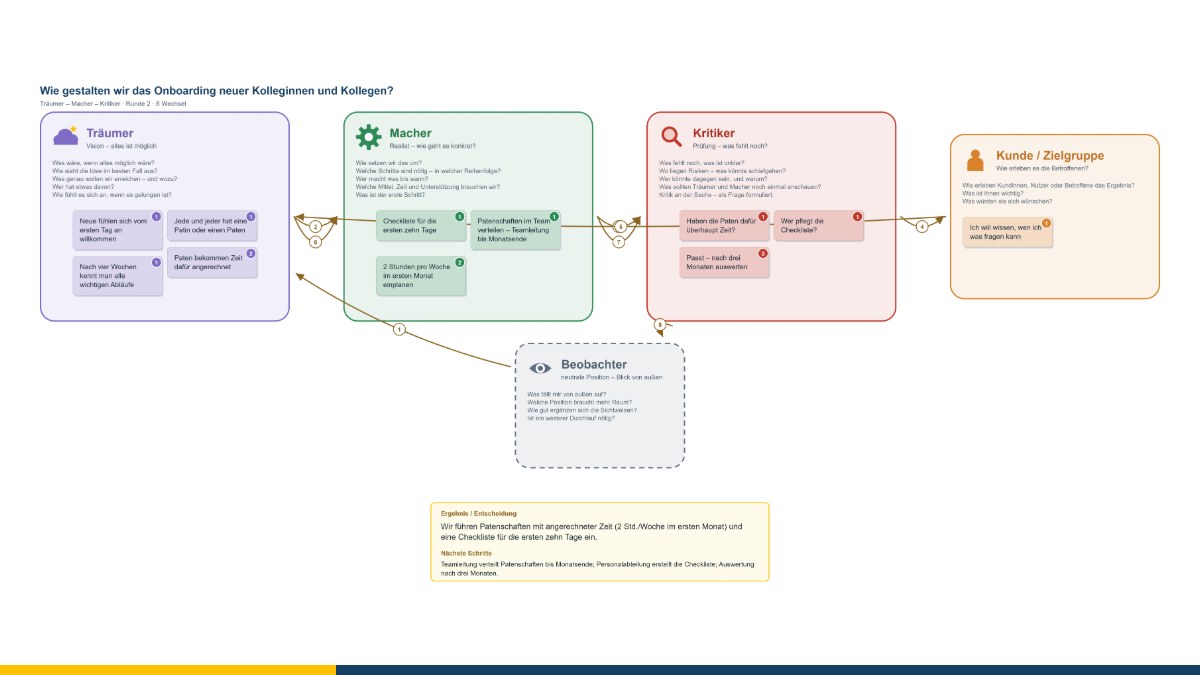
No sooner has an idea been voiced than the “Yes, but …” follows. Many good ideas fail not because of their quality, but because dreaming, planning and checking happen at the same time and hold each other back. The Dreamer – Realist – Critic method, known as the Walt Disney strategy, separates these three ways of thinking – and gives each of them its own place in the room.
The aim of the method
Each of the three roles matters – but not at the same time. The Dreamer may think freely without being judged. The Realist asks how it can work in practice. The Critic checks what is still missing and phrases objections as questions about the matter, not about the person. By deliberately switching between the positions, an idea gets better over several rounds instead of being dropped early on.
The method suits individuals as well as teams: for new products and services, project ideas, career plans or changes in the organisation.
Where the method comes from
Robert Dilts, a developer and trainer in the field of neuro-linguistic programming, studied the thinking strategies of well-known creative figures in his series “Strategies of Genius”. In the first volume (1994), he described how Walt Disney developed ideas: his staff reported that he switched between three attitudes – the Dreamer, the Realist and the Critic. Dilts turned this into a method in which each attitude is given a place of its own. Quite apart from its origins, the method is widely used today in creativity techniques, project work, facilitation and coaching.
How the method is applied
- Clarify the question and define three places in the room – plus a neutral observer position.
- Dreamer: What if anything were possible? What does the idea look like at its best? There is no judging here.
- Realist: How do we put this into practice? Which steps, resources and support are needed? What is the first step?
- Critic: What is still missing? Where are the risks? What should the Dreamer and the Realist look at again?
- Back to the Dreamer: a new round begins with the Critic’s questions.
- Close: when the Critic finds nothing essential any more, record the result and the next steps.
Before each switch, it is worth pausing briefly in the observer position: What has emerged so far? Which position needs more space?
Additional positions can enrich the method – for example the customers’ perspective, a benevolent mentor, a guardian who asks what should stay, a supporter, your own future self or a decision-maker who brings everything together at the end.
Working with the tool
- Positions as areas: Dreamer, Realist, Critic and Observer, each with its own guiding questions. Arranged as a triangle, a row (“path through the room”) or a circle.
- Additional positions: customer or target group, mentor, guardian, supporter, future self, decision-maker – and positions of your own.
- Contributions: notes go into the current position. Each change of position is recorded as a numbered arrow; every new entry into the Dreamer position starts a new round.
- Covering areas: if you wish, only the Dreamer area is open at first, with Realist and Critic covered next to it – the Observer stays visible. Switching into a covered position uncovers it. That way each way of thinking keeps to itself until it is its turn.
- Time per position: a time limit can run if you wish.
- Record and export: a printable record with the question, the picture, contributions per position and round, the path and the result. Export as PDF, PowerPoint, LibreOffice Impress, Visio, SVG, PNG and as a table for Excel.
The tool runs entirely in your browser and does not transmit any data. It is free of charge and available as free software under the GPL: Open the Dreamer–Realist–Critic tool in your browser.
Walking the positions in 3D
The method thrives on changing places – which is why there is also a 3D version. There, the Dreamer, Realist, Critic and Observer lie in the room as floor anchors, each with its own symbol. A figure, such as “Team”, walks the positions in rounds; the path appears as numbered arrows, and each new entry into the Dreamer position moves the count on by one round. Notes lie as cards next to their position and show in which round they were made.
From each position you can look into the room – just as you would if you were standing there. This helps above all when working by video, when nobody can actually walk through the room. The additional positions such as customer, mentor or future self can be added, as can people, symbols and objects. The result and next steps appear on the printable picture sheet; files can be transferred between the 2D and 3D tools. Open the 3D Dreamer–Realist–Critic tool in your browser.
The method serves as a technique for reflection and creativity, not as a diagnostic instrument. Coaching does not replace psychotherapy.
Frequently asked questions
How do I work with covered areas?
In the 2D tool, click “Cover areas” on the right under “Sequence”. Without a current position the exercise starts in the Dreamer: its area is open, Realist and Critic lie covered next to it, and the Observer stays visible. A covered area shows only its symbol and name; its guiding questions and notes are hidden. As soon as you switch into the Realist at the top, the tool uncovers it. At the end, “Uncover all” shows everything again, in the export too.
Can I start with the Critic instead?
Yes – for projects under time pressure that is a proven variant. Switch into the Critic first and then click “Cover areas”: Dreamer and Realist stay covered until it is their turn. You can also cover or uncover individual areas in their properties.
Is covering available in 3D as well?
No. In the 3D version the positions lie in the room as floor anchors; there, changing places separates the ways of thinking.
Conclusion
Dreaming, planning, checking – one after the other rather than all at once: this is how ideas turn into viable projects. If you would like to use the method in a workshop or in coaching, I will be glad to support you, for example with facilitation. Get in touch for a free initial consultation.
Source: Dilts, R. B. (1994): Strategies of Genius, Volume I: Aristotle, Sherlock Holmes, Walt Disney, Wolfgang Amadeus Mozart. Capitola: Meta Publications.
Trademark notice: Disney is a registered trademark of Disney Enterprises, Inc. The name is used here only to refer to the method named after Walt Disney; there is no connection with the trademark owners.
Open or download the tools
- Dreamer – Realist – Critic toolOpen Download (579 KB)
- 3D Dreamer – Realist – CriticOpen Download (795 KB)
Thinking further
You can find more on this topic under resources and downloads – or talk to me directly in a free initial consultation.
Comments
Comments are published immediately with your name. Only the name, title, comment text and time are stored – see the privacy policy.
Loading comments …