
This article was created with the AI assistant Claude and published by Peter Hoenig.
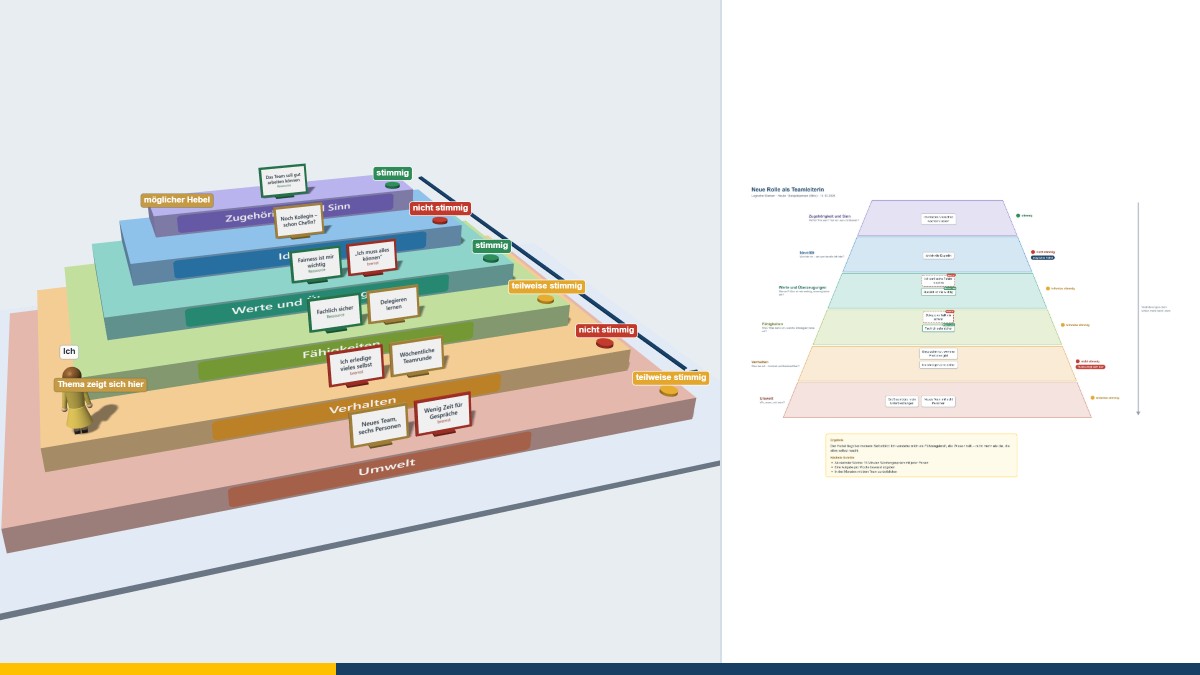
Some problems can be solved with a new tool or better planning. Others cannot – because they lie on a different level: in a belief (“I have to be able to do everything myself”), in your own role or in the question of what it is all for. The logical levels model helps you sort a concern by these levels and find the point at which a change will have the greatest effect.
The aim of the method
The levels answer different questions: Environment – where, when, with whom? Behaviour – what do I do? Capabilities – how, what am I able to do? Values and beliefs – why is this important to me, what do I believe? Identity – who am I in this situation? Belonging and purpose – where do I belong, what for and for whom do I do this?
A concern often shows itself on a lower level – in behaviour or in circumstances – while the lever lies a level higher. A newly appointed team leader who has “no time for conversations” (behaviour) may need not so much a time management seminar as clarity about the belief “I have to do everything myself” and about how she sees her role. Conversely, whatever is aligned on all levels holds firm.
For companies, the model links well with my 8-Level Model: environment and tools, behaviour and processes, capabilities, values, identity and finally vision and mission.
Where the method comes from
In the 1960s and 1970s, the anthropologist and systems theorist Gregory Bateson described various logical levels of learning. Robert Dilts, a developer and trainer in neuro-linguistic programming, took up this idea in the 1980s and shaped it into the model of neurological or logical levels, which he described in detail in 1990. Today it is widely used in coaching, team development and leadership development – often as the “Dilts pyramid”.
How to work with the logical levels
- Name the concern.
- Collect from the bottom up: What shows up in the environment, in behaviour, in capabilities, in values and beliefs, in identity, in purpose?
- Mark what supports you (resource) and what holds you back.
- Assess each level: Is it aligned, partly aligned or not aligned? Where does the issue show itself, where might there be a lever?
- Sketch a target picture: What would each level look like if things were going well?
- Work your way back down from the top and record the first steps.
It is precisely the conscious walking up and down – in the room, with floor anchors for each level – that brings the method to life in coaching.
Working with the logical levels tool
- Pyramid with six levels: collect entries for each level on the left or place them directly in the picture; guiding questions help. Templates for an individual and for a team or organisation.
- Resources and brakes: each card can be marked as supporting or holding back.
- Assessment: record the alignment for each level and mark where the issue shows itself and where a lever might lie.
- One guiding question through all levels: instead of separate questions per level, you can ask the same question on all six levels. Enter your initiative on the right; “▶ Level by level” at the top of the picture starts with the environment. Every answer becomes a card on that level, and after the top level you arrive at the assessment. The question and the initiative also appear in the picture above the pyramid.
- Target picture: a copy of the picture can be changed independently; the record shows “Today” and “Target picture” with all differences.
- Saving and export: save as a file, printable record, export as PDF, PowerPoint, LibreOffice Impress, Visio, SVG, PNG and as a table for Excel.
The tool runs entirely in your browser and does not transmit any data. It is free of charge and available as free software under the GPL: Open the logical levels tool in your browser.
The levels as a staircase in 3D
In the 3D version, the six levels become the steps of a staircase: the environment at the bottom, belonging and purpose at the top. The cards stand on the steps like small display boards, and markers show the alignment for each level. A figure climbs up the levels – and from its point of view you look at the levels above. What does my behaviour look like when I am standing on the step of my values? Today and target picture can be compared side by side; files can be transferred between the board and the 3D version. Open the 3D logical levels in your browser.
In coaching, the logical levels serve as a model for reflection and dialogue, not as a diagnostic instrument. Coaching does not replace psychotherapy.
Frequently asked questions
How does the tool guide me through all levels with one question?
On the right, under “Guiding question through all levels”, enter your initiative – for example “New role as team leader”. Then click “▶ Level by level” at the top of the picture. The tool starts at the bottom with the environment and asks the same question on every level: “When I think of my initiative – what is true on this level?” You type your answers on the right; each becomes a card on that level. You also note how aligned the level is and whether the issue shows itself there. “Next level ▶” (or Enter in the empty field) takes you one step up. After belonging and purpose you arrive at the assessment: on which level does the real issue lie, and where is a lever? The pyramid shows it at a glance.
Can I change the guiding question?
Yes. The same section shows the question as a suggestion, and you can reword it – for a team, “When we think of our initiative …” is already preset in the “Team or organisation” template. If you prefer separate questions per level, switch off “One guiding question for all levels”; the questions of the individual levels remain available as supporting questions either way.
Why does the top question read “Where do I belong?”
The level of belonging and purpose looks beyond yourself: what larger whole do I belong to – what for and for whom do I do this? Since November 2026, the short form “Where do I belong? What for, for whom?” appears in the 2D tool and on the 3D staircase. Files you saved earlier keep their original wording.
Is the walk-through with one question also available in 3D?
The 3D staircase takes its own route: a figure climbs the levels, and each step has its own guiding questions. The walk-through with one shared question is part of the 2D tool; files can be transferred between the two versions.
Conclusion
If you know on which level a concern lies, you look for the solution in the right place. If you are taking on a new role, facing a change or would like to realign a team, I will be glad to support you through Business Coaching or team development. Get in touch for a free initial consultation.
Sources: Bateson, G. (1972): Steps to an Ecology of Mind. San Francisco: Chandler. – Dilts, R. B. (1990): Changing Belief Systems with NLP. Cupertino: Meta Publications.
Open or download the tools
- Logical levels toolOpen Download (672 KB)
- 3D logical levelsOpen Download (783 KB)
Thinking further
You can find more on this topic under resources and downloads – or talk to me directly in a free initial consultation.
Comments
Comments are published immediately with your name. Only the name, title, comment text and time are stored – see the privacy policy.
Loading comments …