
This article was created with the AI assistant Claude and published by Peter Hoenig.
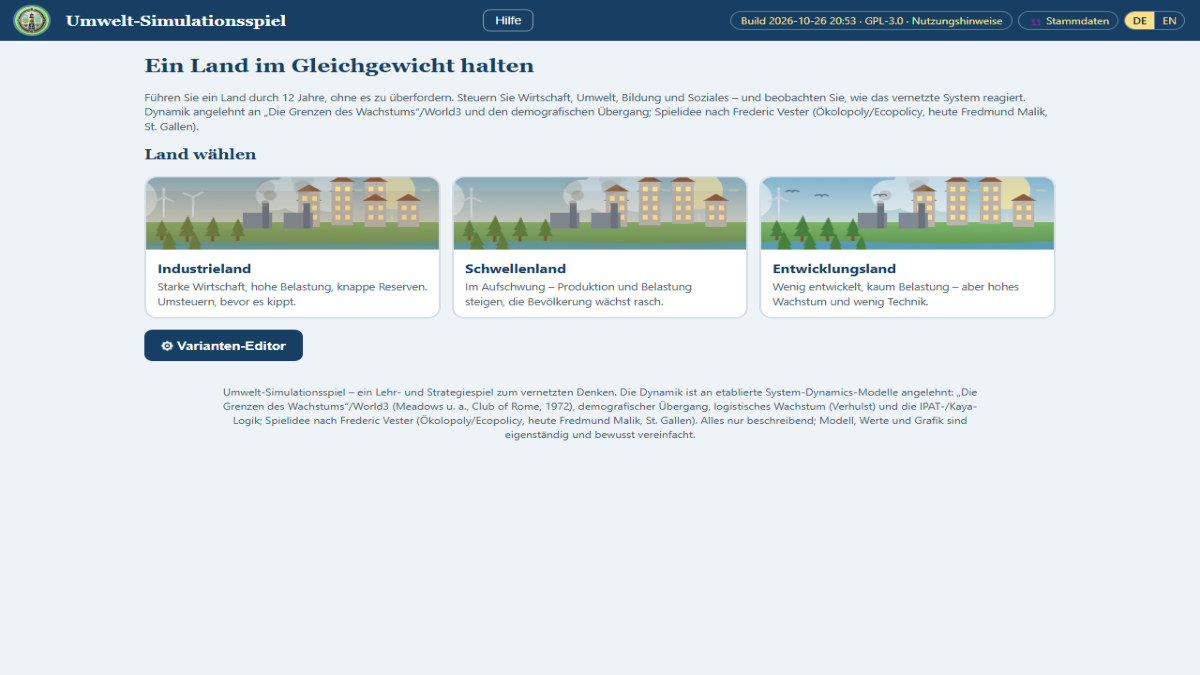
Most games reward quick reactions. This one rewards the opposite: thinking ahead, considering side effects and being patient. Among the small collection of games in my tools you will find the environment simulation game – a learning and strategy game about networked thinking. It runs in your browser and transmits nothing.
How to play
Each year you have a limited number of action points to distribute across your four levers. The game then works out the consequences: betting on production alone drives up the environmental burden and depletes resources; remediating everything leaves you without economic strength. The aim is not a quick record, but keeping the country in balance over twelve years.
What makes it compelling is that the quantities influence one another – often with a delay. A decision only takes effect years later, and sometimes exactly the opposite way from what you expected. Short-sighted growth can lead to overshoot and collapse; far-sighted steering to lasting affluence. If you lose your political support or the environment tips over, the game ends early.
What lies behind it
The game is deliberately simplified, but based on established models: on the study "The Limits to Growth" and the World3 world model (Meadows et al., Club of Rome, 1972), on the demographic transition, on logistic growth (Verhulst) and on the IPAT logic of environmental burden. The idea for the game goes back to Frederic Vester's Ökolopoly, or Ecopolicy® (Ecopolicy® is a trademark of its owner); the game is independently implemented. What this means in detail I explain for everyone without prior knowledge in a separate post: Networked thinking – why simple cause and effect often leads you astray.
Frequently asked questions
How does a year of play work?
You distribute your action points across the four levers with + and – and click “Simulate year ▶”. The effects then run visibly through the system one after another; “Skip ⏭” cuts this short. Afterwards your adviser gives an assessment, and you see the year under “Feedback loops”, “History” and “Landscape”. “Next year ▶” takes you on, and in the final year “To the result ▶”.
How is the result assessed?
The result is an overall score out of 100 with a rating ranging from “Governed exemplarily” through “A solid result” to “Got through – on a shaky foundation”. If you fail early, you read “Failed early”, and the score is halved. The overall score takes in quality of life, the environment, political support, a stable population, affluence and resources. Below it, following my guiding question, stands “Does it serve people?” – with a score of its own drawn from quality of life, the environment and political support.
How do I play a variant of my own?
On the start page, “⚙ Variant editor” opens a window for starting values (0 to 100), the number of years (6 to 24), the coupling strength and a name. “💾 Save” stores the variant in your browser – it then appears under “Your own variants” –, “⬇ As file” saves it as a file, “⬆ Load file” brings a saved variant back into the editor, and “▶ Play” starts straight away.
In short
A game that invites you to pause rather than to rush – an independent implementation and free of charge as free software under the GPL: Open the environment simulation game. The models and names mentioned are mentioned only descriptively. If you want to understand your organisation as a system and shape it so that it serves people, do get in touch with me for a free initial consultation.
The environment simulation game is a simplified learning and thought model, not a scientific forecasting tool.
Open or download the tool
- Environmental Simulation GameOpen Download (452 KB)
Thinking further
You can find more on this topic under Ressourcen und Downloads – or talk to me directly in a free initial consultation.