
This article was created with the AI assistant Claude and published by Peter Hoenig.
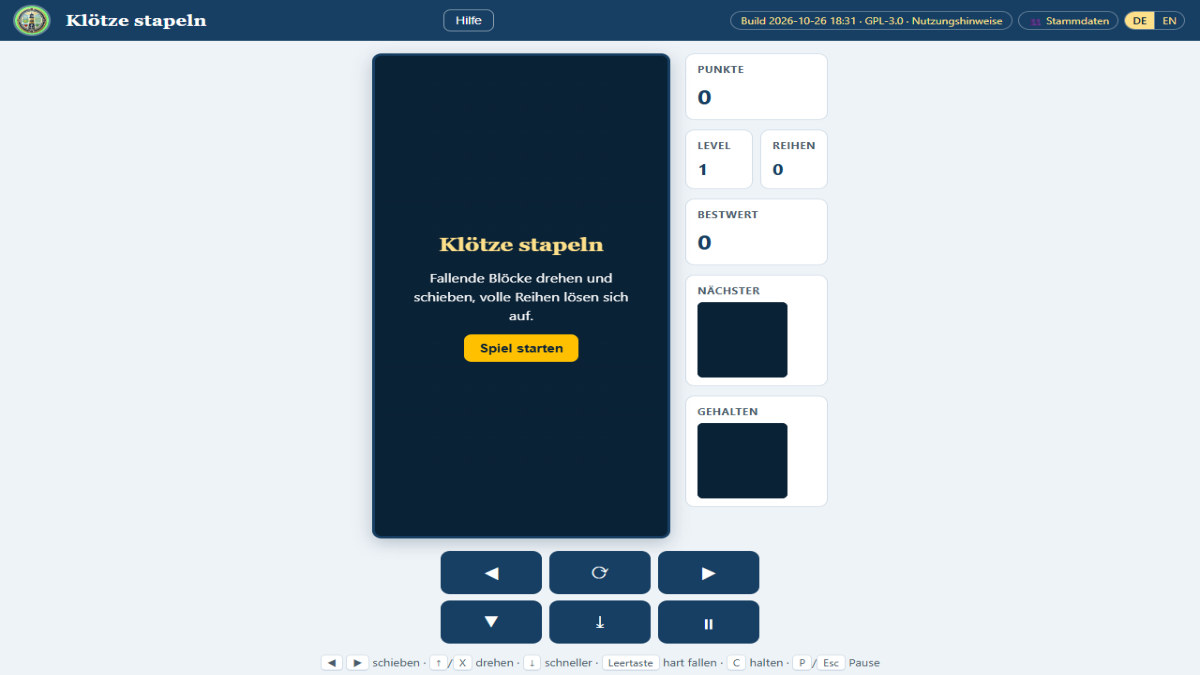
Probably the best-known game of skill of all – in a self-contained, free version: in the little collection of games among my tools there is Stack the blocks. It runs in your browser and transmits nothing.
How to play
The blocks fall from the top into the field. Rotate and shift them so that they fit together as gaplessly as possible. A completely filled row disappears and scores points. The more rows you have managed, the faster it gets – until the field is full.
Functions at a glance
- Keyboard: the left and right arrows slide, the up arrow or X rotates clockwise, Y anticlockwise, the down arrow makes the block fall faster, the space bar drops it hard; P or Esc pauses, Enter starts a new game.
- Buttons below the field: ◀ and ▶ slide, ⟳ rotates, ▼ and ⤓ drop, ⏸ pauses – this is also how you play on a phone.
- Hold: with C or Shift you put a block aside and use it later – once per block. It then appears under “Held”.
- Preview and landing spot: “Next” shows the following block, a faint outline the spot where the block will land.
- Points: one row 100, two 300, three 500, four at once 800 – each multiplied by the level; falling faster scores one point per cell, a hard drop two. The “Best” score stays only in your browser.
Frequently asked questions
When does the level go up, and how fast does it get?
The level rises by one for every ten rows you clear; “Lines” and “Level” are shown next to the field. In the first level a block drops one row every 0.8 seconds, and with each further level it gets noticeably faster. Because the points for full rows are multiplied by the level, late rows are worth particularly much.
Which blocks are there, and how random are they?
There are the seven familiar shapes made of four squares each. The game deals them as if from a bag: each of the seven shapes comes up once before the bag is shuffled again. So no shape stays away for long. The playing field is ten squares wide and twenty high.
How exactly does rotating work?
The up arrow or X rotates clockwise, Y or Z anticlockwise – so the key sits next to X on both German and English keyboards. If the rotated shape does not fit where it is, for instance right at the edge, the game tries to shift it one or two squares to the side; if that fails, the block stays as it was. The square block does not rotate.
When is the game over?
As soon as a block sticks out over the top edge or a new block can find no room. Then “Game over” appears with your score and the question “Try again?”. Press Enter or “New game” to start again; your best score is kept.
In short
A self-contained stacking game, free of charge as free software under the GPL: Open Stack the blocks. Tetris® is a registered trademark; this game is a self-contained implementation of the well-known gameplay and has no connection to it. If you would like to shape your tools and processes in your company so that they serve people, get in touch with me for a free initial consultation.
Stack the blocks is a game for entertainment during the short break.
Open or download the tool
- Stack the Blocks (game)Open Download (401 KB)
Thinking further
You can find more on this topic under Ressourcen und Downloads – or talk to me directly in a free initial consultation.