
This article was created with the AI assistant Claude and published by Peter Hoenig.
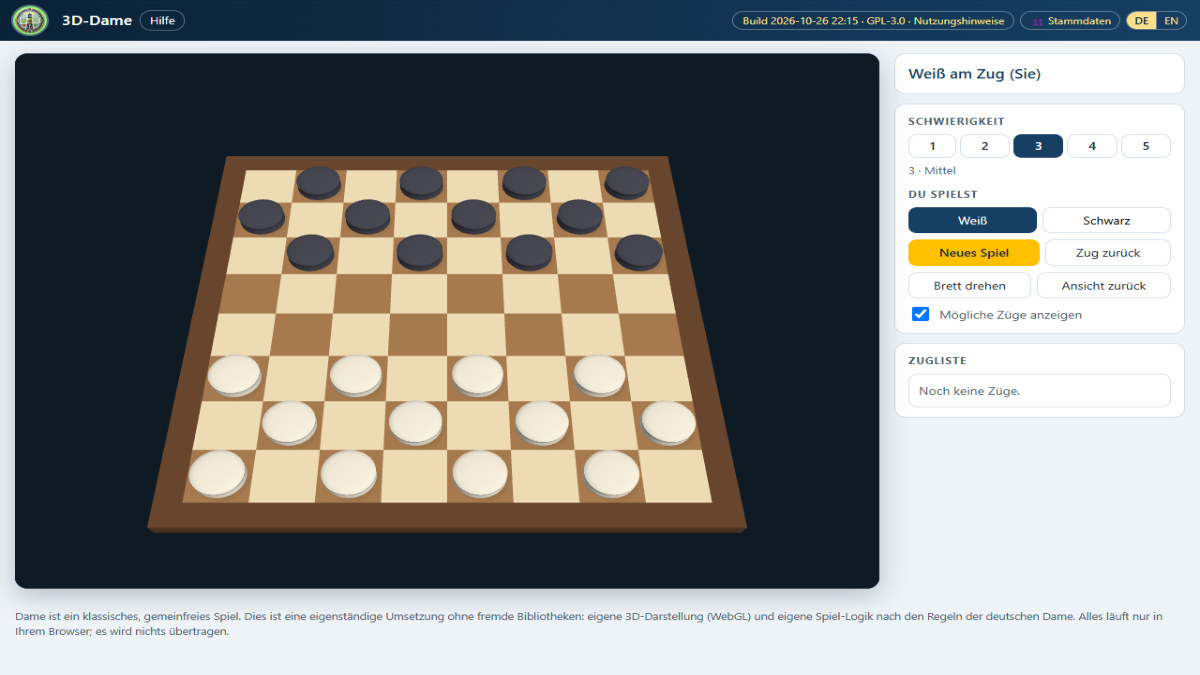
Draughts is quickly learned and yet surprisingly deep – the forced capture in particular compels you to think ahead. In the little collection of games among my tools there is 3D draughts against the computer, in its own spatial presentation. It runs in your browser and transmits nothing.
How to play
You play against the computer. The possible moves are shown; where a capture is possible, forced capture applies. If a piece reaches the opponent's back row, it becomes a king and may continue to move and capture. With "take back" you take the last move back, and the camera can be rotated around the board.
Functions at a glance
- “Difficulty”: levels 1 to 5 – Beginner and Easy make deliberate mistakes, Medium looks a few moves ahead, Advanced and Hard calculate deeper.
- “You play”: you choose White or Black and start with “New game”.
- Moving: tap one of your pieces – the target squares are marked (dot = move, ring = landing square of a jump) – then the target square. When a capture is required, only pieces that can capture are selectable; one tap carries out a whole multiple jump.
- “Take back”: takes back your last move together with the computer's reply.
- “Rotate board” and “Reset view”: view from the other side or the standard view. Dragging on the board rotates the camera, the mouse wheel or two fingers zoom.
- “Show possible moves”: switches the move hints on or off; level, colour and move hints stay only in your browser.
- “Help” (F1): all the rules of German draughts and the controls.
Frequently asked questions
When is a game won or drawn?
You lose if it is your turn and you cannot move – because you have no pieces left or all of them are blocked in. The status line then reads, for example, “White wins – you win!”. A game ends in a draw after the same position has occurred three times, or when for a long time only kings have moved without any capture. The status line then shows “Draw (threefold repetition)” or “Draw (40 moves without a capture or piece move)”.
What exactly are the capture rules?
Capturing is compulsory, including further jumps: if another capture is possible from the landing square, the jump continues until no more jumps are possible. Captured pieces are only removed at the end of the move. Ordinary pieces capture forwards and backwards. A king captures at a distance: it jumps over exactly one opponent and lands on any free square behind it. When a capture is due, the status line shows “Capture required – White to move” or “Capture required – Black to move”.
What do the entries in the move list mean?
As in chess, the squares are named a to h and 1 to 8. A dash stands for a simple move, such as c3–d4, an x for a capture; in a multiple jump all the landing squares follow one after another, such as c3xe5xg7. A D at the end (from the German “Dame”) shows that the piece became a king on that move.
Is a game in progress saved?
No. The game only remembers the difficulty, your colour and the “Show possible moves” setting – only once you change one of them, and only in your browser. If you reload the page, a new game begins; switching colour also starts a new game straight away.
In short
A complete draughts game with its own presentation and its own engine, free of charge as free software under the GPL: Open 3D draughts. If you would like to shape your tools and processes in your company so that they serve people, get in touch with me for a free initial consultation.
3D draughts is a game for entertainment and practice; the computer engine makes no claim to tournament strength.
Open or download the tool
- 3D Draughts (game)Open Download (424 KB)
Thinking further
You can find more on this topic under Ressourcen und Downloads – or talk to me directly in a free initial consultation.