
This article was created with the AI assistant Claude and published by Peter Hoenig.
“Just ask why five times” sounds like a technique that needs no tool. And so it is – until the third why. After that two things reliably happen: the chain branches, because one step has more than one cause, and sooner or later an answer points at a person. Both decide whether the analysis is worth anything.
Five is a guide, not a law
Sometimes three steps are enough, sometimes it takes seven. The measure is not the number but the kind of answer: as long as it points at a symptom, you keep going. As soon as it points at a process or a rule, you have arrived.
An example from a production plant – invented, but most of them follow this pattern:
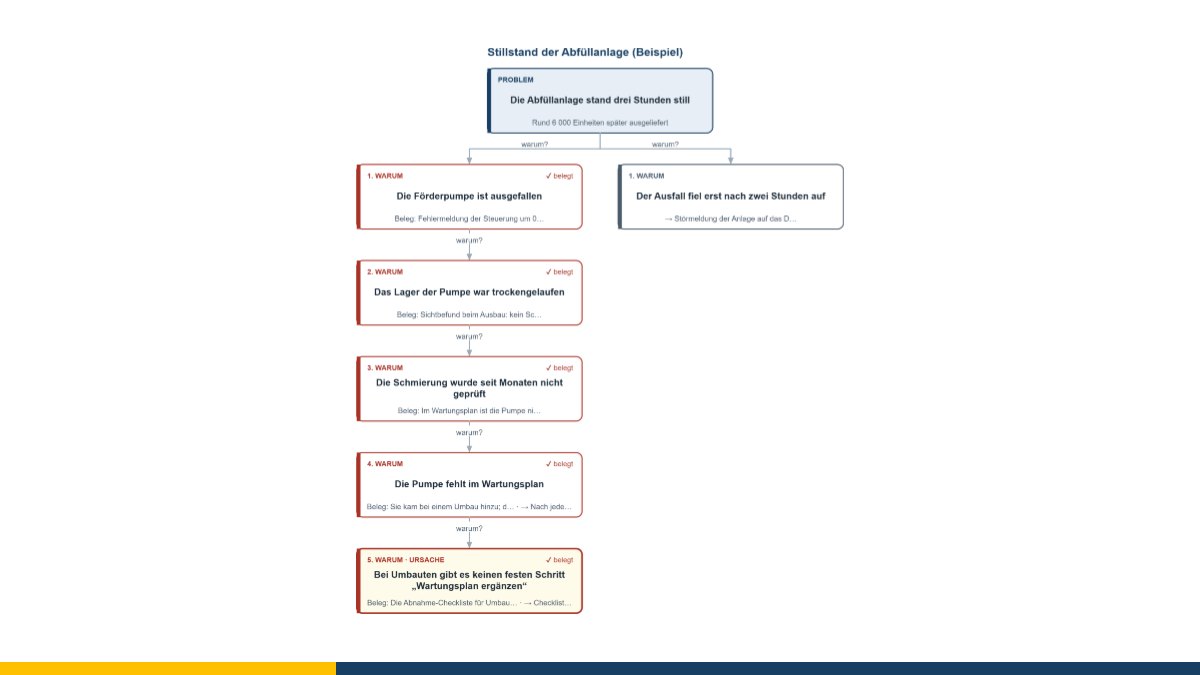
- The filling line stood still for three hours. Why?
- The feed pump failed. Why?
- The bearing had run dry. Why?
- Lubrication had not been checked for months. Why?
- The pump is missing from the maintenance plan. Why?
- When equipment is modified, there is no fixed step “update the maintenance plan”.
Only the sixth answer is a cause you can do something with – an item on the acceptance checklist. Had you stopped after step two, you would have replaced a pump and seen the same thing again in two years.
Evidence keeps the chain honest
Every step has a field “how do we know that?”. It sounds like bureaucracy and it is the difference between an analysis and a story. “Visual inspection on removal: no lubricant film, running marks” is something other than “the bearing was surely dry”. Only with evidence can you later decide where the chain bends – and where to take another look.
When the answer points at a person
This is the most important point, and the tool flags it. If an answer reads “because Mr X forgot”, the chain is not finished. It is standing at its most dangerous spot.
The next question is then not “why did he forget?” but:
What made the forgetting possible – and what should have caught it?
The difference is not politeness but effectiveness. A cause that could only be removed by different behaviour from individual people is not a cause, it is a hope. People forget things; that is not an exception but a constant. A process that relies on error-free people is itself the error.
And by the way: once somebody has been named in a review, you will learn noticeably less at the next incident. Blame-free questioning is therefore not merely decent, it is the precondition for getting any information at all.
Several strands are welcome
A single chain tempts you to settle on the first explanation. In reality a step often has two causes that are both true. “Strand alongside” creates a second branch at the same level, and the picture forks. In the example above a second strand belongs next to the pump: the outage was only noticed after two hours. That has nothing to do with the pump – and it cost half the downtime.
Where it comes from and where it goes
The five whys rarely stand alone:
- From the cause-and-effect diagram a collected cause arrives as the starting point – the diagram says where to look, the chain says how deep.
- From the incident timeline an outage arrives with its sequence of events as the problem.
- A ticket arrives from the ITSM tool – directly inside the MC4Y productivity suite, otherwise as a handover.
- The finished chain with its measures goes out into the knowledge base of the ITSM tool; cause, workaround, solution and measures also go back to the problem in the ITSM tool.
- If you wish, the measures become tasks in the suite or, without the suite, cards on the Kanban board; their status then appears at the step.
For interwoven causes that reinforce each other the right tool is the causal loop diagram instead – a chain reaches its limit there.
Integration: maintain once, use everywhere
My principle for all the tools: a piece of information is maintained once and is then available wherever it is needed. For the five whys that means:
- Master data: the owners of the measures can be linked to the master data.
- CMDB: no connection – the chain asks about processes, not components.
- ITSM: you fetch a problem or an incident from the ITSM tool – directly inside the suite, otherwise as a handover. The title becomes the problem; a cause already recorded in the ITSM becomes the first, still suspected level. Cause, workaround, solution and measures with deadline and owner go back into the problem (method “5 whys”); you can see here whether the ITSM has taken them over. If you wish, a draft entry for the solution database is created from it.
- Tasks and Kanban: every level with a measure is handed over as a task in the suite or as a card to the Kanban board; the status comes back and is shown with the level.
- Other tools: the cause-and-effect diagram (a selected cause) and the incident timeline (the incident as a problem) can also supply the start of a chain.
Without the suite everything runs in the browser – via files and handovers within the same browser; nothing leaves your computer.
The five whys tool is free of charge and available as free software under the GPL: open the five whys. If the same problems keep coming back in your company, I am happy to look at them with you – get in touch for a free initial consultation.
Open or download the tools
- Cause-and-effect diagram (Ishikawa, fishbone)Open Download (760 KB)
- Incident timeline and reviewOpen Download (772 KB)
- ITSM tool (incidents, problems, changes)Open Download (1.2 MB)
- Kanban boardOpen Download (693 KB)
- Impact network toolOpen Download (699 KB)
- Master data (people, roles, organisation)Open Download (681 KB)
- Five whys (chain of causes)Open Download (757 KB)
Thinking further
You can find more on this topic under process management consulting – or talk to me directly in a free initial consultation.
Comments
Comments are published immediately with your name. Only the name, title, comment text and time are stored – see the privacy policy.
Loading comments …